

Divorce is not only a legal process. It is an emotional turning point.
For some people, divorce comes after years of pain, silence, arguments, betrayal, family pressure, loneliness, or broken trust. For others, it comes after both partners realize that the relationship cannot continue in a healthy way.
When a marriage ends, people often feel confused. They may ask:
Should I hire a divorce lawyer?
Should we try divorce mediation?
Can we avoid court?
What happens to children?
What happens to property?
Will mediation save money?
Do I still need legal advice?
What if my spouse is controlling or abusive?
These questions matter because the divorce path you choose can affect cost, stress, privacy, timing, custody, property division, and long-term peace.
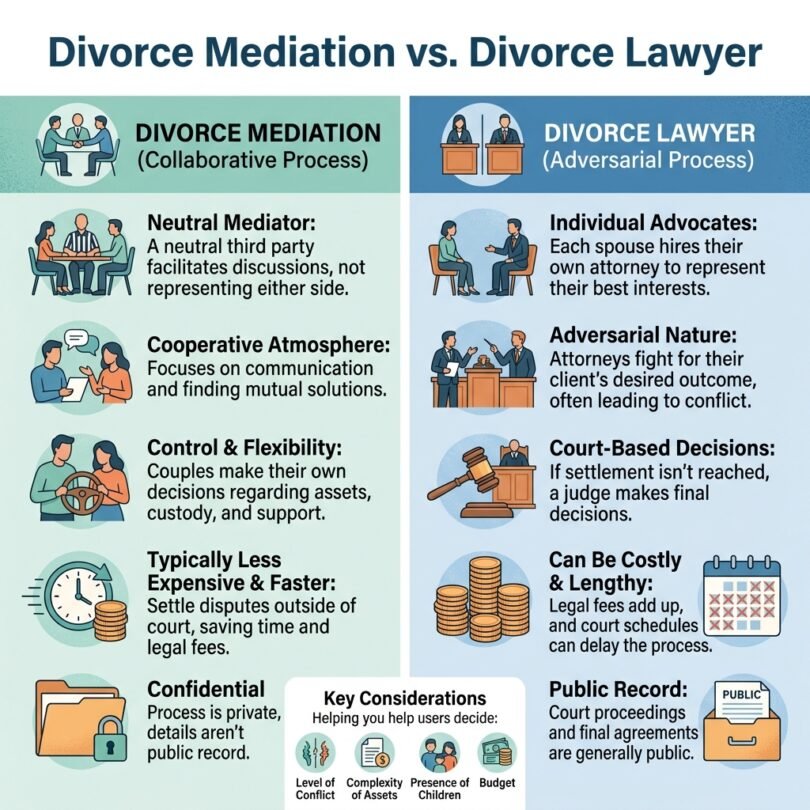
Divorce mediation and hiring a divorce lawyer are not always opposites. In many cases, mediation and legal advice can work together. A mediator helps spouses negotiate. A lawyer protects legal rights, explains risks, reviews agreements, and represents one spouse’s interests.
The American Bar Association explains that mediation can give people a quicker and less expensive way to resolve differences while addressing everyone’s needs and interests. The ABA also notes that in many dispute resolution processes, attorneys may participate as counselors or advocates, depending on the process.
But mediation is not right for every divorce. If there is abuse, fear, hidden money, serious power imbalance, child safety concerns, or a spouse refusing to be honest, hiring a lawyer may be safer and more appropriate.
This guide explains divorce mediation vs divorce lawyer, how each option works, costs, pros and cons, when mediation may be better, when a lawyer may be necessary, and how to choose the right path.
Important Legal and Safety Disclaimer
This article is for general informational purposes only. It is not legal, family law, financial, tax, mental health, domestic violence, or professional advice.
Divorce laws vary by country, state, province, religion, court system, marriage type, property rules, custody rules, and personal situation. Always consult a qualified family law attorney or licensed professional in your location before making legal decisions.
If you are facing domestic violence, threats, coercive control, stalking, intimidation, child safety concerns, or fear of retaliation, do not rely on mediation alone. Contact local emergency services, a domestic violence hotline, a qualified lawyer, or trusted support organization immediately.
What Is Divorce Mediation?
Divorce mediation is a process where spouses work with a neutral mediator to reach agreements about divorce-related issues.
A mediator does not usually make decisions for the couple. Instead, the mediator helps both spouses communicate, identify issues, discuss options, and work toward a written agreement.
Justia explains that divorce mediation is an alternative to traditional divorce proceedings, where a neutral third party helps spouses negotiate issues such as child custody and property division instead of leaving decisions to a judge.
Divorce mediation may cover:
- Child custody
- Parenting time
- Child support
- Spousal support
- Property division
- Debt division
- Retirement accounts
- Business interests
- House or real estate decisions
- Insurance
- Tax-related responsibilities
- Future communication rules
- School and medical decisions for children
- Holiday schedules
- Dispute resolution after divorce
The mediator helps guide conversation, but the spouses usually make the final decisions.
What Is a Divorce Lawyer?
A divorce lawyer is an attorney who represents one spouse in the divorce process.
A divorce lawyer can:
- Explain legal rights
- File divorce paperwork
- Represent the client in court
- Negotiate with the other spouse or lawyer
- Review settlement offers
- Protect custody rights
- Address property division
- Handle support issues
- Investigate hidden assets
- Prepare legal documents
- Advise on legal risks
- Help with emergency orders
- Help in domestic violence situations
- Advocate for one spouse’s interests
Unlike a mediator, a lawyer is not neutral. A lawyer represents one client.
If both spouses have separate lawyers, each lawyer advises and protects their own client.
Divorce Mediation vs Divorce Lawyer: Main Difference
The biggest difference is role.
Divorce Mediator
A mediator is neutral.
The mediator helps both spouses communicate and negotiate.
A mediator generally does not represent either spouse.
Divorce Lawyer
A lawyer represents one spouse.
The lawyer gives legal advice to that spouse and protects that spouse’s interests.
Simple Example
If both spouses agree on most things and want a peaceful process, mediation may help.
If one spouse is hiding money, threatening the other, refusing to cooperate, or trying to take advantage, a lawyer may be necessary.
Is Mediation the Same as Having a Lawyer?
No.
A mediator and a lawyer are different.
A mediator helps both people talk and reach agreement. A lawyer gives legal advice to one person.
The ABA notes that attorneys are not always required in dispute resolution, but attorneys may participate as counselors or advocates depending on the process.
In many divorce cases, the safest option is not “mediation only” or “lawyer only.” It may be:
Mediation plus independent legal advice.
This means spouses use mediation to negotiate but each spouse may have a lawyer review the agreement before signing.
Divorce Mediation: Pros and Cons
Pros of Divorce Mediation
1. Usually Less Conflict
Mediation is designed to reduce hostility.
Instead of fighting in court, spouses talk with the help of a neutral mediator.
This can be especially helpful when children are involved.
2. More Privacy
Court cases can create public records. Mediation is usually more private.
Couples who value privacy may prefer mediation.
3. More Control
In court, a judge decides.
In mediation, spouses have more control over the final agreement.
This can lead to more practical and personalized solutions.
4. Often Faster
Mediation may move faster than court litigation, especially when both spouses cooperate.
The government of the Netherlands explains that mediation can help former partners communicate effectively and make agreements about children, partner maintenance, child maintenance, and other matters.
5. Often Lower Cost
Mediation can cost less than a contested court battle.
Nolo says divorce mediators may commonly charge around $100 to $350 per hour, depending on credentials and training.
Costs vary widely, but mediation is often less expensive when spouses cooperate.
6. Better Co-Parenting Foundation
If spouses will share children after divorce, mediation may help them build a healthier communication pattern.
7. Flexible Solutions
Mediation allows creative agreements that may not happen in court.
For example:
- Flexible parenting schedules
- Customized holiday plans
- Gradual home sale timelines
- Shared expense systems
- Communication boundaries
- Child activity agreements
Cons of Divorce Mediation
1. Not Safe for Every Relationship
Mediation may not be safe if there is abuse, threats, intimidation, coercion, or fear.
A spouse may agree to unfair terms because they feel pressured.
2. Mediator Does Not Represent You
A mediator is neutral. The mediator does not protect only your interests.
You may still need a lawyer to review the agreement.
3. Requires Cooperation
Mediation works best when both spouses are willing to be honest and negotiate.
If one spouse refuses to cooperate, mediation may fail.
4. Hidden Assets Can Be a Problem
If one spouse hides money, business income, accounts, property, or debt, mediation may not uncover everything.
A lawyer may be needed for discovery and investigation.
5. Power Imbalance Can Lead to Unfair Agreement
If one spouse controls money, documents, language, transportation, immigration status, or family pressure, mediation can become unfair.
6. Still Needs Legal Filing
Even if mediation works, divorce papers must usually be filed with the court.
Divorce Lawyer: Pros and Cons
Pros of Hiring a Divorce Lawyer
1. Legal Protection
A lawyer explains your rights and risks.
This is important because divorce agreements can affect your future for years.
2. Stronger Help in Complex Cases
A lawyer is important when there are:
- Children
- Custody disputes
- Property disputes
- Business ownership
- Hidden assets
- Retirement accounts
- High debt
- Spousal support
- Immigration concerns
- Domestic violence
- Protective orders
- International issues
- One spouse refusing to cooperate
3. Court Representation
If your case goes to court, a lawyer can represent you.
4. Negotiation Support
A lawyer can negotiate with the other spouse or their lawyer.
This can reduce the pressure on you.
5. Document Review
Divorce paperwork can be complicated. A lawyer can review settlement terms before you sign.
6. Emergency Legal Help
If there is abuse, child safety risk, frozen bank accounts, or urgent housing concerns, a lawyer may help request emergency court orders where available.
7. Protects Against Unfair Pressure
If one spouse is more powerful, more informed, or controlling, a lawyer can help balance the process.
Cons of Hiring a Divorce Lawyer
1. Higher Cost
Divorce lawyers often cost more than mediation.
Legal fees vary widely by location, lawyer experience, case complexity, and whether the divorce is contested.
2. May Increase Conflict
Some legal battles become highly adversarial.
This can increase emotional stress and damage co-parenting relationships.
3. Less Control
If the case goes to court, a judge may make decisions for both spouses.
4. Longer Timeline
Contested divorce can take longer than mediation.
5. Emotional Stress
Court filings, hearings, legal letters, and negotiations can be emotionally draining.
Divorce Mediation vs Divorce Lawyer: Cost Comparison
Cost depends on location and complexity.
Mediation Costs
Mediation costs may include:
- Mediator hourly fee
- Session fees
- Document preparation
- Court filing fees
- Lawyer review fee
- Parenting plan drafting
- Agreement drafting
Nolo says divorce mediators often charge about $100 to $350 per hour, depending on training and credentials.
Mediation may be cheaper if both spouses cooperate and have simple issues.
Lawyer Costs
Lawyer costs may include:
- Retainer
- Hourly fees
- Court filings
- Document drafting
- Negotiation time
- Discovery
- Hearings
- Trial preparation
- Expert witnesses
- Appraisals
- Custody evaluations
Lawyer costs rise when spouses fight over custody, property, support, business ownership, or hidden assets.
Cheapest Is Not Always Best
Choosing the cheapest path can be expensive later if the agreement is unfair.
For example:
- You may waive rights without understanding them.
- You may accept unfair custody terms.
- You may miss hidden assets.
- You may agree to support terms that are difficult to change.
- You may divide debt unfairly.
- You may create tax problems.
- You may sign unclear parenting rules.
The best choice is the one that is safe, fair, legally sound, and realistic.
When Divorce Mediation May Be Better
Mediation may be better when:
- Both spouses are respectful enough to negotiate
- There is no abuse or fear
- Both spouses understand finances
- Both spouses are willing to disclose documents
- Custody issues are not extreme
- Property division is not too complex
- Both want privacy
- Both want lower conflict
- Both want to avoid court
- Both are willing to compromise
- Both can communicate with guidance
Good Mediation Scenario
A couple agrees the marriage is over. They both care about the children. They disagree on details but are willing to talk. They both share bank records and property details. There is no intimidation.
Mediation may help.
When a Divorce Lawyer May Be Better
A lawyer may be better when:
- There is domestic violence
- One spouse is afraid
- One spouse controls money
- One spouse hides assets
- One spouse refuses to disclose documents
- There are serious custody concerns
- There are threats or stalking
- There is a business to divide
- There are large assets or debts
- There are retirement accounts
- There are immigration concerns
- One spouse has already hired a lawyer
- The case is highly contested
- Emergency court orders may be needed
- You do not understand your rights
Good Lawyer Scenario
One spouse controls all bank accounts, refuses to share documents, threatens to take the children, and pressures the other spouse to sign quickly.
This is not a good mediation-only situation. A lawyer is important.
Can You Use Both Mediation and a Lawyer?
Yes.
Many people use both.
This can be a strong approach.
Option 1: Mediation With Lawyer Review
Spouses attend mediation.
After reaching a draft agreement, each spouse has their own lawyer review it.
This can help prevent unfair or unclear terms.
Option 2: Lawyer-Supported Mediation
Each spouse has a lawyer during mediation.
The lawyers may attend sessions or advise between sessions.
Option 3: Mediation First, Lawyer If Needed
Spouses try mediation.
If mediation fails, they hire lawyers and continue through negotiation or court.
Option 4: Lawyer First, Mediation Later
Lawyers help prepare the case, gather documents, and clarify rights.
Then spouses mediate unresolved issues.
The ABA’s 2026 family mediation article says mediation, with proper legal representation, can result in similar outcomes without adversarial and potentially damaging effects on families.
Divorce Mediation vs Litigation
Divorce litigation means going through the court process, where lawyers argue issues and a judge may decide.
FindLaw explains that divorce mediation is an alternative to litigation where a neutral third-party mediator helps couples resolve differences without extensive litigation, giving spouses more control over outcomes.
Mediation
Best for:
- Cooperation
- Privacy
- Lower conflict
- Faster resolution
- Flexible agreements
- Couples who can negotiate safely
Litigation
Best for:
- Abuse or fear
- Hidden assets
- Serious custody conflict
- Spouse refusing to cooperate
- Emergency orders
- Complex legal disputes
- Need for judge decision
Litigation is not always bad. Sometimes court protection is necessary.
Key Divorce Issues to Consider
1. Child Custody
Custody decisions affect where children live, school decisions, medical decisions, holidays, travel, and parenting time.
Mediation can help cooperative parents create a parenting plan.
A lawyer may be needed if there are concerns about:
- Safety
- Abuse
- Neglect
- Substance abuse
- Parental alienation
- Relocation
- Refusal to co-parent
- Threats involving children
2. Child Support
Child support rules vary by location.
A mediator can help discuss support, but a lawyer can explain legal requirements.
3. Spousal Support
Spousal support may depend on:
- Length of marriage
- Income difference
- Earning ability
- Health
- Caregiving roles
- Standard of living
- Local law
Do not sign support terms without understanding long-term impact.
4. Property Division
Property division may include:
- House
- Cars
- Savings
- Investments
- Retirement accounts
- Business assets
- Jewelry
- Personal property
- Inherited assets
- Debt
- Loans
- Credit cards
Mediation may work for simple property division. A lawyer may be better for complex assets.
5. Debt Division
Debt can be as important as assets.
Consider:
- Credit cards
- Personal loans
- Car loans
- Mortgage
- Business debt
- Tax debt
- Student loans
- Family loans
6. Retirement Accounts
Retirement division can be legally complex.
Mistakes can create tax problems or lost benefits.
7. Business Ownership
If one or both spouses own a business, a lawyer and valuation expert may be needed.
8. Taxes
Divorce can affect filing status, dependents, property transfers, support, retirement division, and home sale issues.
Get professional tax advice where needed.
Mediation Safety Checklist
Before choosing mediation, ask:
- Do I feel safe speaking honestly?
- Is there any threat or fear?
- Does my spouse control money?
- Are all bank records available?
- Are all assets disclosed?
- Are there child safety concerns?
- Can I say no without punishment?
- Do I understand my legal rights?
- Can I afford lawyer review?
- Is the mediator qualified?
- Does the mediator explain neutrality?
- Can I pause mediation if needed?
- Do I have private access to legal advice?
If the answer raises concern, speak with a lawyer before mediating.
Lawyer Selection Checklist
Before hiring a divorce lawyer, ask:
- Do they specialize in family law?
- How many divorce cases have they handled?
- Do they handle custody disputes?
- Do they handle mediation support?
- What is their hourly rate?
- What retainer is required?
- What costs are not included?
- Will they encourage settlement when possible?
- Will they explain options clearly?
- How do they communicate?
- Who will work on the case?
- What is their courtroom experience?
- Do they understand domestic violence issues?
- Do they explain risks honestly?
A good lawyer should not only fight. A good lawyer should guide.
Questions to Ask a Divorce Mediator
Ask:
- What training do you have?
- Are you licensed as an attorney, therapist, or mediator?
- Do you provide legal advice or only mediation?
- How do you handle power imbalance?
- What happens if one spouse hides information?
- How many sessions are typical?
- What is the hourly rate?
- Do you prepare written agreements?
- Should each spouse get lawyer review?
- What happens if mediation fails?
- Do you screen for domestic violence?
- Can sessions be online?
- Is mediation confidential?
- How are children’s issues handled?
Emotional Side of Divorce
Divorce is not only paperwork.
It can bring:
- Grief
- Shame
- Anger
- Fear
- Loneliness
- Confusion
- Relief
- Guilt
- Family pressure
- Financial stress
- Parenting worries
- Identity changes
People may grieve the person, the memories, the home, the future they imagined, and the version of themselves they were in the marriage.
This is why support matters.
During divorce, consider:
- Therapy
- Trusted family support
- Legal advice
- Financial organization
- Safety planning if needed
- Journaling
- Healthy routines
- Avoiding public social media fights
- Protecting children from conflict
- Rest before major decisions
Do not sign major legal agreements when emotionally pressured, exhausted, or afraid.
Common Divorce Mediation Mistakes
Mistake 1: Using Mediation When You Feel Unsafe
Mediation requires safe negotiation. Fear changes everything.
Mistake 2: Not Getting Legal Review
A mediator is neutral. A lawyer protects your interests.
Mistake 3: Hiding Information
Mediation depends on honesty.
Mistake 4: Agreeing Too Quickly
Do not sign just to end emotional pain.
Mistake 5: Ignoring Taxes
Property and support decisions may have tax consequences.
Mistake 6: Not Planning Parenting Details
A vague parenting plan can create future conflict.
Mistake 7: Ignoring Debt
Debt division matters.
Mistake 8: Choosing an Unqualified Mediator
Divorce mediation needs skill and training.
Mistake 9: Letting Family Pressure Decide
Divorce terms affect your life, not only your relatives’ opinions.
Mistake 10: Not Thinking Long-Term
A fast agreement may not be a fair agreement.
Common Divorce Lawyer Mistakes
Mistake 1: Hiring the Most Aggressive Lawyer Only
Aggression can increase cost and conflict.
Mistake 2: Not Asking About Fees
Understand hourly rates, retainers, and extra costs.
Mistake 3: Hiding Facts From Your Lawyer
Your lawyer needs the full truth.
Mistake 4: Fighting Over Everything
Some fights cost more than they are worth.
Mistake 5: Using Children as Leverage
This can harm children and damage your case.
Mistake 6: Ignoring Settlement Options
Court is not always the best path.
Mistake 7: Not Reading Documents
Always read before signing.
Mistake 8: Choosing a Lawyer Without Family Law Experience
Divorce law is specialized.
Mistake 9: Expecting Guaranteed Results
No lawyer can guarantee the outcome.
Mistake 10: Letting Anger Drive Strategy
Legal strategy should protect your future, not only express pain.
Divorce Mediation vs Divorce Lawyer: Which Is Better?
There is no one answer for everyone.
Choose Mediation If:
- Both spouses can communicate safely
- Both are honest about money
- Both want lower conflict
- Both want privacy
- Both are willing to compromise
- Issues are manageable
- There is no abuse or fear
- Both can get legal review if needed
Choose a Lawyer If:
- You feel unsafe
- Your spouse is controlling
- Assets are hidden
- Custody is disputed
- Support is disputed
- There is domestic violence
- Your spouse hired a lawyer
- There are complex assets
- You do not understand your rights
- You need court protection
Choose Both If:
- You want mediation but need legal protection
- You want lower conflict but still need advice
- You want a lawyer to review the agreement
- You have children or property but can negotiate
- You want a balanced and careful process
Final Verdict
Divorce mediation can be a peaceful, private, and lower-cost path when both spouses are honest, safe, and willing to cooperate.
A divorce lawyer may be necessary when there is conflict, fear, hidden money, custody risk, power imbalance, complex property, or legal uncertainty.
The best option is often not mediation vs lawyer. It may be mediation with independent lawyer review.
If your divorce is simple and respectful, mediation may help. If your divorce is complex or unsafe, legal representation may protect you. If you are unsure, speak with a qualified family law attorney before signing anything.
A divorce agreement can affect your children, home, income, debt, retirement, and future peace. Do not choose only the fastest option. Choose the option that is safe, fair, and legally informed.
FAQs About Divorce Mediation vs Divorce Lawyer
What is the difference between divorce mediation and a divorce lawyer?
A mediator is neutral and helps both spouses negotiate. A divorce lawyer represents one spouse and gives legal advice to protect that person’s interests.
Is divorce mediation cheaper than hiring a lawyer?
Often, yes. Mediation can be cheaper when both spouses cooperate. Nolo says mediators may commonly charge around $100 to $350 per hour, depending on credentials and training.
Do I need a lawyer for divorce mediation?
You may not be required to have a lawyer, but it is often wise to have a lawyer review any agreement before signing. ABA guidance explains that attorneys may participate in dispute resolution as counselors or advocates depending on the process.
Is mediation good for child custody?
Mediation can help cooperative parents create a parenting plan. However, if there are safety concerns, abuse, neglect, threats, or serious custody disputes, a lawyer may be necessary.
Is mediation safe in abusive relationships?
Not always. If there is abuse, fear, threats, coercion, or control, mediation may be unsafe. Contact emergency services, a domestic violence support service, or a lawyer.
Can a mediator give legal advice?
Usually, a mediator is neutral and does not represent either spouse. Some mediators may be attorneys, but they still do not act as both spouses’ lawyer in mediation. Get independent legal advice.
Is a divorce lawyer always necessary?
Not always. Some simple uncontested divorces may be handled through mediation or self-help forms, depending on local law. But legal advice is important when rights, children, property, support, or safety are involved.
What happens if mediation fails?
If mediation fails, spouses may continue negotiation through lawyers or proceed to court, depending on local divorce process rules.
Is divorce mediation legally binding?
Mediation discussions are not automatically the same as a final divorce decree. A written agreement usually must be properly prepared, signed, and approved by the court according to local rules.
Which is better for complex property division?
A lawyer is usually better for complex property division, especially when there are businesses, retirement accounts, real estate, investments, hidden assets, or major debt.
Can we use one lawyer for both spouses?
Usually, one lawyer cannot ethically represent both spouses in a divorce because spouses may have conflicting interests. A mediator can be neutral, but each spouse may need separate legal advice.
What is the best option for a peaceful divorce?
For a peaceful divorce, mediation with independent lawyer review can be a strong option. It may reduce conflict while still protecting legal rights.