

Some people feel calmer, safer, and emotionally stronger when they are with an animal.
A dog may help someone feel less alone after a breakup. A cat may comfort someone dealing with anxiety. A small animal may help a person feel grounded during emotional stress. For people living with certain mental or emotional health conditions, an animal can become part of daily emotional support.
This is why many people search for an emotional support animal letter online.
But this topic is confusing.
Many websites promise “instant ESA letters,” “official ESA registration,” “certified emotional support animal ID cards,” or “guaranteed landlord approval.” Some people pay money and receive documents that may not be accepted. Others misunderstand the difference between an emotional support animal, service animal, therapy animal, and ordinary pet.
The rules are also different for housing, flights, hotels, workplaces, universities, and public places.
In the United States, emotional support animals may be relevant in housing accommodation situations under fair housing rules, but they are not the same as trained service animals. For air travel, the U.S. Department of Transportation treats service animals differently from emotional support animals, and airlines are generally no longer required to treat emotional support animals as service animals.
HUD describes an assistance animal as an animal that works, provides assistance, performs tasks, or provides emotional support that alleviates one or more identified effects of a person’s disability. HUD also says assistance animals are not pets. The U.S. Department of Transportation explains that a service animal for air travel is a dog individually trained to do work or perform tasks for a person with a disability.
This guide explains what an emotional support animal letter is, when it may matter, how online ESA letters work, what they may cost, what rules to check, and how to avoid scams.
Important Legal, Housing and Mental Health Disclaimer
This article is for general informational purposes only. It is not legal, medical, mental health, housing, disability rights, airline, veterinary, insurance, or professional advice.
Emotional support animal rules can vary by country, state, city, landlord, housing provider, airline, school, workplace, and individual situation. Laws and agency guidance may also change. Always verify requirements directly with a licensed mental health professional, qualified attorney, housing authority, official government source, landlord, airline, or relevant provider before relying on any ESA letter.
If you are facing a mental health crisis, immediate danger, severe distress, or thoughts of self-harm, contact local emergency services or a crisis support service immediately. An emotional support animal is not a substitute for emergency care, therapy, medication, or professional treatment when those are needed.
What Is an Emotional Support Animal?
An emotional support animal, often called an ESA, is an animal that provides comfort, emotional support, companionship, or relief for a person with a mental or emotional health condition.
An ESA may help with:
- Anxiety
- Depression
- Loneliness
- Panic symptoms
- Post-traumatic stress symptoms
- Grief
- Emotional distress
- Social isolation
- Stress
- Adjustment difficulties
An emotional support animal does not need the same specialized task training as a service animal.
That is one major difference.
A service animal is trained to perform specific tasks for a person with a disability. An emotional support animal provides comfort or emotional benefit mainly through its presence.
What Is an Emotional Support Animal Letter?
An emotional support animal letter is a document written by a licensed healthcare or mental health professional stating that a person has a disability-related need for an emotional support animal.
A legitimate ESA letter may include:
- Provider name
- Provider license information
- Provider contact details
- Date of letter
- Confirmation of professional relationship or evaluation
- Statement that the person has a disability-related need
- Explanation that the animal provides emotional support related to that need
- Provider signature
- Letterhead, where applicable
- State or jurisdiction details, where relevant
The exact requirements can vary.
A real ESA letter is not just a certificate, badge, registration number, vest, or ID card. It should come from a qualified licensed professional who has evaluated the person.
Emotional Support Animal vs Service Animal
This difference is extremely important.
Emotional Support Animal
An emotional support animal provides comfort or emotional support.
It usually does not have to be trained to perform a specific disability-related task.
Common ESA animals may include:
- Dog
- Cat
- Rabbit
- Bird
- Small animal
- Other domesticated animals, depending on housing rules and reasonableness
Service Animal
A service animal is trained to perform specific work or tasks for a person with a disability.
Examples:
- Guiding a blind person
- Alerting a deaf person
- Pulling a wheelchair
- Alerting before seizures
- Interrupting harmful behavior
- Retrieving medication
- Performing psychiatric service tasks
The U.S. Department of Transportation says airlines recognize as service animals dogs that are individually trained to do work or perform tasks for the benefit of a qualified person with a disability.
Therapy Animal
A therapy animal usually visits hospitals, schools, nursing homes, or programs to provide comfort to many people.
A therapy animal is not the same as an ESA or service animal.
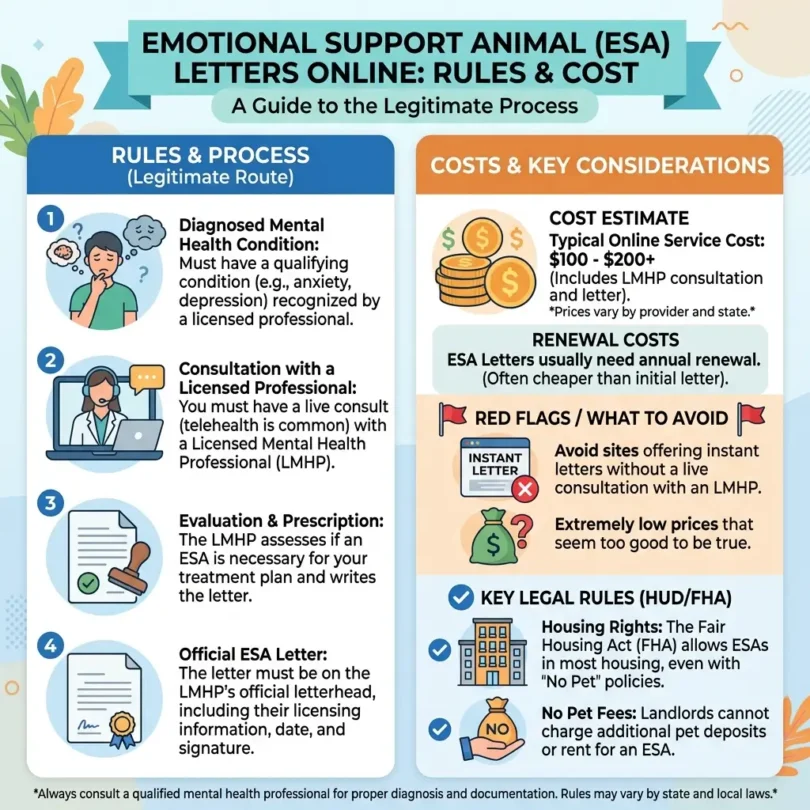
Emotional Support Animal Letter Online: How It Works
Getting an ESA letter online usually involves several steps.
Step 1: Choose a Legitimate Provider
A legitimate provider should connect you with a licensed mental health or healthcare professional.
Avoid sites that only sell certificates, registrations, vests, or ID cards.
Step 2: Complete an Assessment
You may answer questions about mental health symptoms, daily life, emotional functioning, and why an animal helps.
A real evaluation should be more than a one-click form.
Step 3: Meet With a Licensed Professional
Some providers may require video, phone, or secure online consultation.
The professional should determine whether an ESA is appropriate based on your situation.
Step 4: Receive a Letter If Clinically Appropriate
If the licensed professional decides an ESA is appropriate, they may issue a letter.
A legitimate provider should not guarantee approval before evaluation.
Step 5: Submit to Housing Provider If Needed
If you need housing accommodation, you may submit documentation to the landlord or housing provider according to their process.
Step 6: Respond to Verification Requests
A housing provider may be allowed to verify that the letter is from a licensed provider. They should not demand unnecessary private medical details beyond what rules allow.
ESA Letter for Housing
Housing is the most common reason people seek an ESA letter.
In the U.S., assistance animals may be considered a reasonable accommodation in housing when there is a disability-related need.
HUD states that assistance animals are not pets and may provide emotional support that alleviates one or more identified effects of a person’s disability.
This may matter when a housing provider has:
- No-pet policy
- Pet rent
- Pet deposit
- Breed rules
- Size rules
- Animal limits
What an ESA Letter May Help With
A valid ESA letter may help a tenant request:
- Permission to keep an emotional support animal
- Waiver of no-pet policy
- Waiver of pet rent or pet deposit, where applicable under rules
- Reasonable accommodation for disability-related need
What an ESA Letter Does Not Guarantee
An ESA letter does not automatically mean every animal must be accepted in every situation.
Housing providers may consider issues such as:
- Direct threat
- Serious property damage risk
- Animal behavior
- Undue burden
- Fundamental alteration
- Invalid or unreliable documentation
- Local animal laws
- Health and safety rules
The animal should be well-behaved and not create serious danger or damage.
ESA Letter for Travel
Travel rules are different from housing rules.
Many people mistakenly think an ESA letter allows an animal to fly free in the cabin as an emotional support animal.
That is generally not true in U.S. air travel today.
The U.S. Department of Transportation’s current service animal guidance focuses on trained service dogs. Airlines are not required to treat emotional support animals as service animals.
This means an ESA may need to travel under the airline’s normal pet policy.
Before Flying With an ESA
Check:
- Airline pet policy
- Pet carrier rules
- Size and weight limits
- Cabin availability
- Pet fees
- Breed restrictions
- International entry rules
- Health certificate requirements
- Vaccination records
- Destination rules
- Layover country rules
An ESA letter is usually not enough for airline service animal status.
ESA Letter for Hotels, Restaurants and Public Places
An emotional support animal is usually not the same as a service animal for public access.
Hotels, restaurants, stores, public buildings, and transportation providers may have different rules.
A service animal may have legal access rights in many public places. An ESA may not.
Do not assume an ESA letter allows your animal into every public space.
Always check local law and business policy.
ESA Letter for Workplaces
Workplace accommodation rules are different from housing.
An ESA letter does not automatically require an employer to allow an animal at work.
An employee may need to request accommodation through workplace disability accommodation procedures.
The employer may consider job duties, safety, workplace environment, hardship, allergies, animal behavior, and legal requirements.
Consult HR, an employment lawyer, or disability rights professional if needed.
ESA Letter for College or University Housing
Some students seek ESA letters for dorms or campus housing.
Rules vary by university.
A school may require:
- Disability accommodation request
- Documentation from licensed provider
- Housing office approval
- Animal vaccination records
- Roommate considerations
- Animal care plan
- Behavior rules
- Renewal documentation
Students should contact the disability services office or housing accommodation office before bringing an animal.
How Much Does an Emotional Support Animal Letter Cost?
Costs vary.
An online ESA letter may cost around:
- Low-cost directories: varies by therapist
- Online ESA evaluation services: often around $100 to $200 or more
- Private therapist letter: may be included in therapy or consultation cost
- Follow-up or renewal letter: may cost extra
- State-specific evaluations: may cost more
Some online ESA letter services advertise initial consultations around $150 to $200. However, prices vary and should not be the only factor.
Cheap “instant letters” can be risky if they are not based on a real licensed evaluation.
Cost Factors
ESA letter cost may depend on:
- Provider license type
- State requirements
- Evaluation method
- Consultation length
- Housing-only letter
- Follow-up verification
- Renewal policy
- Whether therapy is ongoing
- Whether the provider is local
- Platform fees
- Urgency
Insurance Coverage
Insurance may or may not cover mental health evaluation related to ESA documentation.
Check with:
- Insurance plan
- Therapist
- Mental health clinic
- Online platform
- Employee benefits provider
How to Know If an Online ESA Letter Is Legit
A legitimate ESA letter should generally come from a qualified licensed healthcare or mental health professional.
Check for:
- Provider full name
- License number
- License type
- State or jurisdiction
- Contact information
- Professional letterhead
- Date
- Signature
- Disability-related need language
- Real evaluation
- Ability to verify provider license
- No fake guarantee
- No “registration only” claim
Provider Types May Include
Depending on rules and location:
- Licensed psychologist
- Licensed clinical social worker
- Licensed professional counselor
- Licensed marriage and family therapist
- Psychiatrist
- Physician
- Psychiatric nurse practitioner
- Other qualified licensed healthcare provider
Verify the License
Before paying, ask:
- What is the provider’s license type?
- Which state is the provider licensed in?
- Can I verify the license online?
- Will the provider have a real consultation?
- Is the letter accepted for housing accommodation requests?
- Does the provider respond to verification requests?
- Are refunds available if no letter is clinically appropriate?
ESA Letter Scams and Red Flags
Be careful. ESA letter scams are common online.
Red Flag 1: “Instant Approval”
A real provider should evaluate you before deciding.
Red Flag 2: “Official ESA Registration”
There is no single official national ESA registry that makes an animal legally valid.
Red Flag 3: Selling Only Certificates or ID Cards
Certificates, vests, tags, and ID cards are not the same as a legitimate ESA letter.
Red Flag 4: No Licensed Professional
If no licensed provider evaluates you, the letter may not be reliable.
Red Flag 5: Guaranteed Landlord Approval
No website can guarantee every landlord or housing provider will approve.
Red Flag 6: No Provider License Number
A vague signature is not enough.
Red Flag 7: Same-Day Letter With No Real Review
Fast service may be possible, but no meaningful evaluation is a warning sign.
Red Flag 8: Pressure Tactics
Be careful with countdown timers, fear-based marketing, and fake urgency.
Red Flag 9: No Refund Policy
Read the refund and cancellation terms before paying.
Red Flag 10: Fake Legal Claims
Avoid websites that claim an ESA has the same public access rights as a service animal.
Emotional Support Animal Letter Safety Checklist
Before buying or requesting an ESA letter online, check:
- Is the provider licensed?
- Can I verify the license?
- Is there a real evaluation?
- Is the letter for housing, not fake travel rights?
- Does the service explain limits clearly?
- Are costs transparent?
- Are privacy policies clear?
- Does it avoid “official registration” claims?
- Does it avoid guaranteed approval promises?
- Does it explain state-specific rules?
- Does it provide provider contact information?
- Does it explain renewal rules?
- Does it protect mental health information?
- Does it avoid selling only vests or ID cards?
- Does it explain that ESA is not a service animal?
What Landlords May Ask
Rules vary, but housing providers may request documentation when the disability or need is not obvious.
They may ask for reliable information showing:
- The person has a disability-related need
- The animal provides assistance or emotional support related to that need
They usually should not ask for unnecessary private medical records or detailed diagnosis in many situations, but exact rules depend on location and current law.
Because housing law can change and differs by jurisdiction, tenants should verify current rules with official housing agencies or legal professionals.
Can a Landlord Reject an ESA?
A landlord may reject or challenge an ESA request in some situations.
Possible reasons may include:
- Invalid documentation
- No disability-related need shown
- Animal creates direct threat
- Animal causes serious property damage
- Request creates undue burden
- Animal is illegal under local law
- Tenant does not control animal
- Documentation appears unreliable
- Housing is exempt under specific rules
Do not assume every request must be approved automatically.
ESA Letter Renewal
Some housing providers may ask for updated documentation if the previous letter is old or if circumstances change.
Renewal rules vary.
Before paying for renewal, ask:
- Is renewal necessary?
- How old is my current letter?
- Does my housing provider require updated documentation?
- Is my provider still licensed?
- Is another evaluation needed?
- Is there a renewal fee?
Emotional Support Animal Responsibilities
Having an ESA is not only a right. It is also a responsibility.
Owners should ensure the animal:
- Is well cared for
- Is not aggressive
- Does not damage property
- Does not create excessive noise
- Is vaccinated where required
- Is clean and healthy
- Is safe around others
- Follows local animal laws
- Does not disturb neighbors
- Is manageable in the home
An ESA should support emotional health without creating serious harm to others.
ESA Letter vs Psychiatric Service Dog
This is another important difference.
Emotional Support Animal
- Provides comfort
- Usually no specific task training
- May be relevant for housing accommodation
- Usually not public access like service animal
- Airline access usually follows pet rules
Psychiatric Service Dog
- Dog trained to perform specific tasks
- Tasks relate to psychiatric disability
- May have service animal rights where applicable
- May help with panic attacks, medication reminders, grounding, interruption of harmful behavior, or other trained tasks
A psychiatric service dog is not the same as an ESA.
Who Should Consider an ESA Letter?
An ESA letter may be appropriate for some people with mental or emotional health conditions where an animal provides meaningful disability-related support.
It may be relevant for people experiencing:
- Anxiety
- Depression
- PTSD symptoms
- Panic symptoms
- Severe loneliness
- Emotional distress
- Grief-related difficulty
- Trauma-related symptoms
- Social anxiety
- Adjustment difficulties
But only a qualified licensed professional can determine whether an ESA letter is appropriate for a specific person.
Who Should Not Rely on an ESA Letter Alone?
Do not rely only on an ESA letter if you need:
- Emergency mental health care
- Psychiatric medication evaluation
- Therapy for severe depression
- Crisis support
- Domestic violence support
- Substance use treatment
- Trauma therapy
- Hospital care
- Legal representation
- Housing court defense
- Airline travel approval
- Public access rights
An ESA may be supportive, but it is not a complete treatment plan.
Questions to Ask Before Paying for an ESA Letter Online
Ask:
- Who will evaluate me?
- What is their license number?
- What state or country are they licensed in?
- Can I verify their license?
- Is there a real consultation?
- Is approval guaranteed?
- What happens if I do not qualify?
- What is the total cost?
- Are there hidden fees?
- Is renewal included?
- Is landlord verification included?
- Is the letter for housing only?
- Does it claim travel rights?
- Is my data private?
- What is the refund policy?
- Can I contact support?
- Does it follow state-specific rules?
Common Mistakes With ESA Letters
Mistake 1: Buying a Fake Certificate
A certificate is not the same as a legitimate ESA letter.
Mistake 2: Trusting “Official Registration”
Registration websites may look official but may not create legal rights.
Mistake 3: Thinking ESAs Can Fly Free
Airline rules changed. ESAs usually travel as pets, not service animals.
Mistake 4: Ignoring Landlord Process
You may need to submit a reasonable accommodation request properly.
Mistake 5: Not Checking Provider License
Always verify the licensed professional.
Mistake 6: Using an Uncontrolled Animal
Bad behavior can create legal and housing problems.
Mistake 7: Expecting Public Access Rights
ESAs do not have the same public access rights as service animals.
Mistake 8: Not Reading Privacy Policy
Mental health information is sensitive.
Mistake 9: Waiting Until Eviction Threat
Ask for help early if housing problems begin.
Mistake 10: Using ESA Letter Instead of Treatment
An ESA may support wellbeing, but it may not replace therapy, medical care, or crisis support.
Emotional Support Animal Letter Online: Best Practices
Use a Licensed Professional
A real ESA letter should come from a licensed provider.
Avoid Instant Registration Sites
Registration alone is not enough.
Keep Documentation Organized
Save:
- ESA letter
- Provider contact information
- Animal vaccination records
- Housing accommodation request
- Landlord communication
- Renewal documentation
- Animal behavior records if needed
Be Honest During Evaluation
Do not fake symptoms. Misuse can harm people with real disabilities.
Respect Others
Manage allergies, noise, property damage, and safety concerns responsibly.
Know the Limits
ESA rules are not the same for housing, travel, public spaces, workplaces, and schools.
Final Verdict: Is an Online ESA Letter Worth It?
An online emotional support animal letter may be worth it if it comes from a legitimate licensed professional after a real evaluation and is used for a valid disability-related housing accommodation request.
It is not worth it if the website only sells certificates, vests, ID cards, instant approvals, or fake registration.
The safest approach is simple:
- Understand the difference between ESA and service animal.
- Use a licensed provider.
- Verify the license.
- Avoid guaranteed approval claims.
- Read housing rules carefully.
- Do not assume airline access.
- Keep your animal well-behaved.
- Ask for legal help if housing problems become serious.
An emotional support animal can be meaningful for emotional healing, but the letter must be legitimate, ethical, and based on real need.
FAQs About Emotional Support Animal Letters Online
What is an emotional support animal letter?
An emotional support animal letter is a document from a licensed healthcare or mental health professional stating that a person has a disability-related need for an emotional support animal.
Can I get an ESA letter online?
Yes, it may be possible to get an ESA letter online if a licensed professional evaluates you and determines that an emotional support animal is appropriate.
Are online ESA letters legal?
Online ESA letters may be valid if they come from a qualified licensed professional after a real evaluation. Letters from fake registration sites or instant certificate sellers may not be reliable.
How much does an ESA letter cost?
Costs vary. Many online ESA evaluation services may charge around $100 to $200 or more, but price does not prove legitimacy.
Is there an official ESA registry?
There is no single official national ESA registry that automatically makes an animal legally valid. A legitimate ESA letter from a licensed professional is more important than a certificate or ID card.
Can a landlord deny an emotional support animal?
A landlord may deny or challenge a request in some cases, such as invalid documentation, direct threat, serious property damage risk, undue burden, or other legally valid reasons.
Can emotional support animals fly free?
In U.S. air travel, airlines generally are not required to treat emotional support animals as service animals. ESAs usually travel under normal airline pet policies.
Is an ESA the same as a service animal?
No. A service animal is trained to perform specific disability-related tasks. An ESA provides emotional support through companionship and is usually not task-trained.
Can an ESA go into restaurants or stores?
Usually, emotional support animals do not have the same public access rights as service animals. Businesses may refuse ESAs depending on local law and policy.
Do I need a mental health diagnosis for an ESA letter?
A licensed professional generally needs to determine that there is a disability-related need for the animal. Exact documentation requirements vary by location and situation.
How long is an ESA letter valid?
Validity can vary by housing provider, local rules, and provider practices. Some letters may need updating after a period of time.
How do I avoid ESA letter scams?
Avoid instant approval, fake certificates, official registration claims, no licensed provider, guaranteed landlord approval, hidden fees, and sites that claim ESAs have the same rights as service animals.